
GRAVATATIONAL LENSING CONTINUED
Illustration of a black hole or dark matter moving through the interstellar medium showing traditional gravitational lensing.

Another powerful tool in the search for dark matter is microlensing. Microlensing by an isolated object was first detected in 1989. Since then it has been used to detect a myriad of things such as exoplanets, brown dwarfs, and black holes. Microlensing functions differently in that it doesn't look for traditional arcs or rings. Rather it looks for the brightening of a background object when a foreground dark object passes in front of it. It's a simple technique with profound implications.
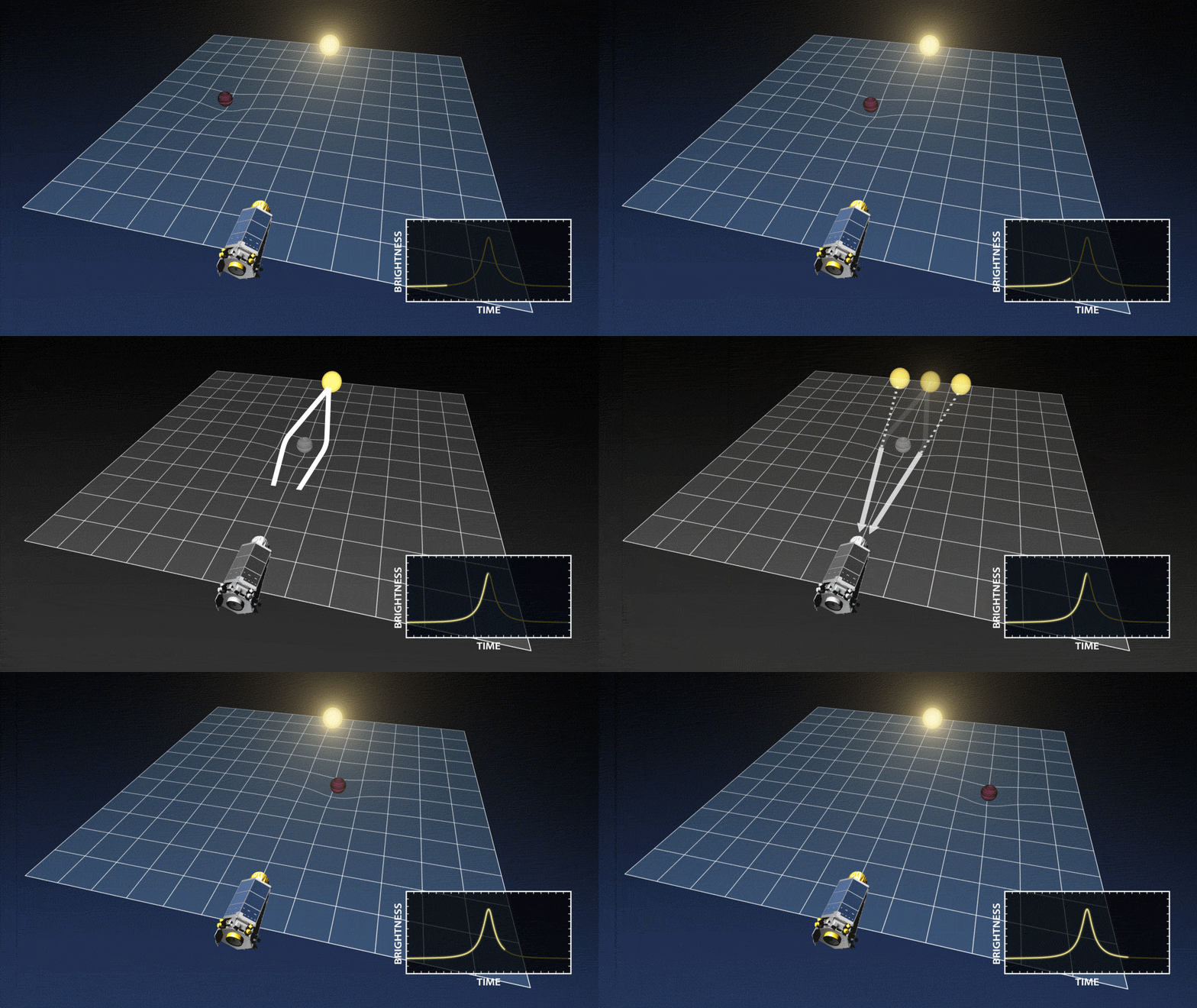
Illustration courtesy of Wikipedia / NASA

Computer simulation of galactic filaments showing cosmic voids and web like structure. (Courtesy Wikipedia)
This brings us to another postulate of incredibly great importance. Large cosmic voids may indeed be vast regions of material that is gravitationally bound, and are large concentrations of C+ dark matter. Clusters of galaxies, including super clusters, are indeed common. Therefore nothing is preventing clusters of dark matter as well.


This is a map of the larger known cosmic voids. (Courtesy Wikipedia)
Further supportive evidence can also be found in ultra high energy cosmic particles arriving here on earth, from these regions of apparent nothingness. Particles such as the Amaterrasu particle at more than 240 EeV (Exa-electronvolts). First detected in 2021 and later identified in 2023, are apparently emanating from the local void. This is an empty area of space bordering the Milky Way Galaxy. Previous extremely high energy cosmic rays have also been observed such as the OMG particle in 1991 at 320EeV.
These ultra high energy cosmic rays are strongly suggestive that these dark areas contain vast concentrations of relativistic high energy matter. Further research will also be needed to discover, if these cosmic rays have suffered entropy over the long distances they have traveled, or are they simply a consequence of normally radiated relativistic energy.

Once again, it is important to recognize that given the enormous volume of galaxies within the universe, as well as their immense size and the super massive black holes at their centers, a great amount of dark matter is additionally being emanated from them. Black holes quite literally are fountains of relativistic C+ matter. They add vast amounts of material to the interstellar medium.
No discussion of cosmic voids would be complete without mentioning Dark Molecular Clouds, Absorption Nebulae and Bok Globules. Indeed they share many similarities with cosmic voids and may also be regions of gravitationally bound C+ matter. Additionally, their irregular shapes bear a striking resemblance to the irregular shapes of large cosmic voids. This strongly suggests gravitational interaction with known visible matter.
Photograph of Barnard 68 in the visible and near infrared light. (Courtesy Wikipedia / NASA)
"There is an Entire Universe of Matter
moving Faster than the Speed of Light"
It is also important to note, that not all dark matter is matter traveling faster than the speed of light. There is matter that is cold and dark enough that it is difficult to detect. Some examples being Black Dwarfs, stars that have long since died, and Dark Interstellar Dust which is also difficult to detect. Any discussion of Dark Matter must also include Dark Antimatter. It should also be noted that not all voids in space are dark matter. Gravitational irregularities sometimes leave some voids with less matter. With our new understanding of dark matter, cosmic voids and galactic filaments, it's tempting to believe that space is homogeneous. However, it is well known that gravitational attraction forms clumps. Space is unquestionably not homogeneous as seen in the famous cosmic microwave background (CMB) map by the Planck Satellite.

Planck Satellite map (Courtesy Wikipedia / ESA)
Any discussion of the speed of light must also include Gravitons!
This is especially true with the recent coinciding confirmations of Gravitational Waves at the Ligo and Virgo Gravitational Wave Observatories. These confirmations have given birth to an absolute wealth of new scientific information as well as a new branch of science, Gravitational Wave Astronomy.

.png)
.png)
Image 1: Ligo Observatory Hanford, Washington State
Image 2 : Ligo 2nd Observatory, Livingston Louisiana
Image 3: Virgo Observatory, Pisa Italy
The first observations were done using Laser Interferometry by the Ligo Observatorieson September 14, 2015 (GW150914). This occurred when two black holes merged. The merger was estimated to be approximately 1.3 billion light years from Earth. The masses of the black holes were approximately 29, and 36 times that of our sun. They spiraled together releasing the energy equivalent to three solar masses. This happened amazingly in only a fraction of a second.

Computer simulation of two black holes merging (Courtesy of NASA/Wikipedia).
GRAVITATIONAL WAVES
Since this discovery, a great many more collisions have been observed. Unquestionably Gravitational Waves permeate the entire Universe. However, presently we are only able to observe large cataclysmic events such as the merger of Black Holes, Neutron Stars and Supernovae. Our detection capabilities are still in their infancy.
Additionally Gravitational Waves also exhibit wavelength just like photons. Interestingly, the wavelength for Gravitational Waves are very long and often measured in light years. The existence of Gravitational Waves also firmly implies the existence of Gravitons, thus making them a fundamental particles just like photons.
With respect to the speed of light, our new knowledge of Gravitational Waves gives further insight to the world of relativistic velocities. This can be easily seen in the first observations by the Ligo and Virgo collaboration of observatories.
The detectors first registered the arrival of only Gravitational Waves. Then approximately 1.7 seconds later, a high-energy gamma ray burst was received. Followed afterwards by x-ray, ultraviolet and eventually infrared photons. The most energetic photons arriving first followed by slower photons afterwards.
These observations and the subsequent delay in the arrival of photons speaks absolute volumes about the speed of light. It produces a clear understanding of the relative velocities. It also is a very clear indicator of the existence of the small Gray Area in, and around the speed of light. It provides powerful evidence that Gravitons do indeed travel a bit faster than the speed of light!
"We have long since known "C" as the speed of light,
it is now necessary to recognize "G" as the speed of Gravitons”
We know that photons can travel immense distances across the Universe. The new James Webb Telescope allows us to see light from the early days of the Universe, approximately 13.5 billion years ago. This is incredibly distant in both space and time. Gravitons travel slightly faster and of course must be more energetic, which further confirms their astounding ability to travel almost unimaginable distances.
One of the strongest proofs of dark matter today is gravitational lensing. As predicted by Einstein, gravitational fields can easily bend light. This manifests itself as multiple images of the same object behind a large gravitational field or sometimes arcs of light. Often the foreground object can be seen, but in many instances it is not visible. This gives us an incredibly helpful tool in our search for dark matter.

Actual photograph of a gravitational lens (image courtesy NASA).

QUANTUM ENTANGLEMENT
By applying our new understanding of velocities faster than the speed of light, it now becomes easy to recognize a vast myriad of applications.
Of great importance is Quantum Entanglement. Einstein once called it "Spooky Action at a Distance". This phenomenon has been known about for a great many years and in recent times even put to use in Quantum Computers. Yet the actual mechanism of entanglement is poorly understood. Einstein himself believed that there is some form of communication between particles.
These particles are exact images of each other, and the act of observing one, directly and instantaneously affects the other. Entangled particles, like all particles, exhibit a well known wave particle duality. Specifically, it is the wave function part of its duality that clearly demonstrates a reflection or mirrored effect. This is occurring at speeds faster than the speed of light. Simply put, the mechanism of communication between entangled particles happens at velocities faster than the speed of light. Additionally, as we know when traveling at relativistic velocities, time stops relative to the observer. This gives the illusion of instantaneous communication.
At specific Distinct Resonant Frequencies reflections do indeed occur. The science of Fluid Mechanics further demonstrates this principle.
This is easily demonstrated with sound waves. A good example being sand placed on a plate vibrated by sound creating fractal like patterns. This was Classically demonstrated by Ernst Chladni in 1787.
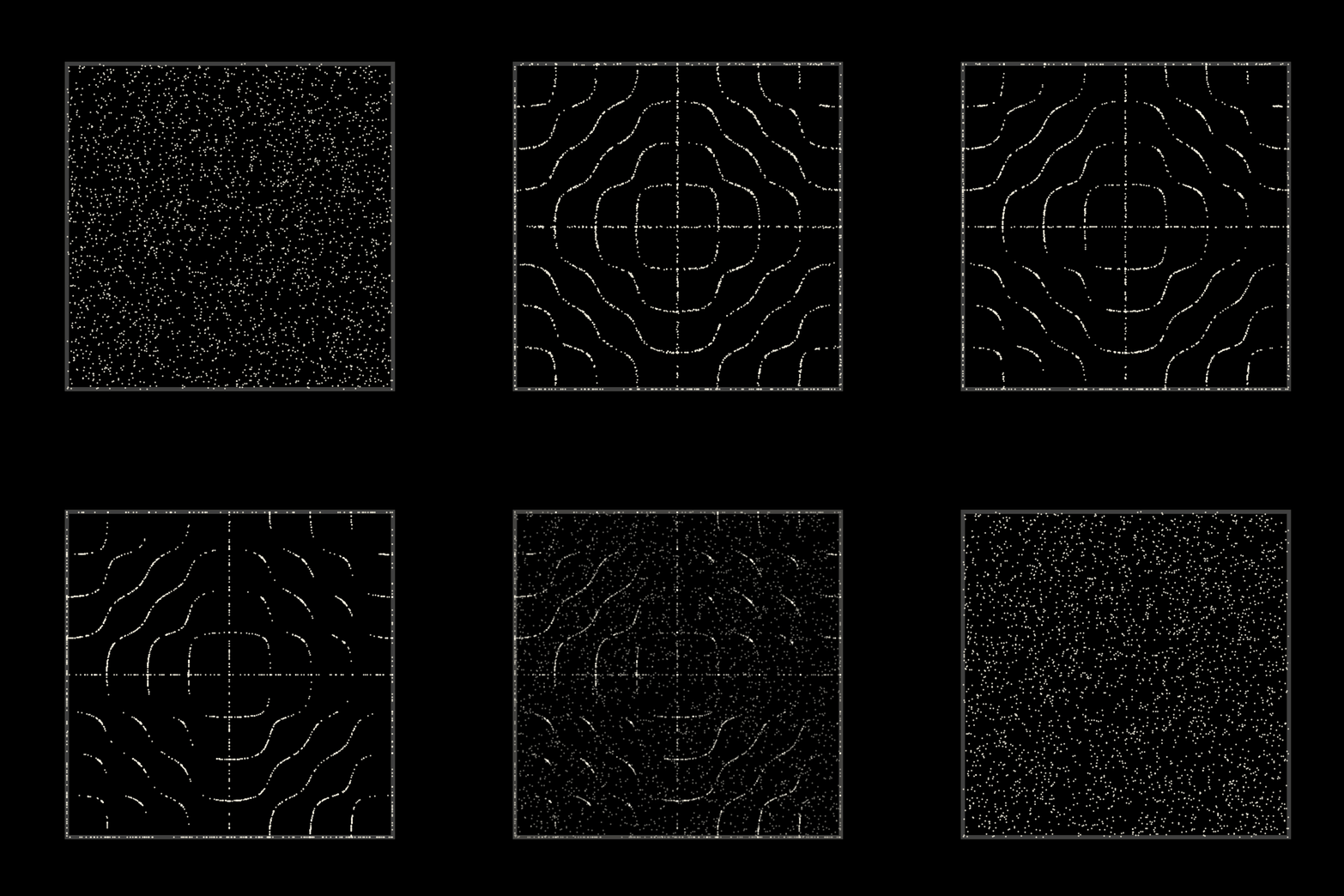
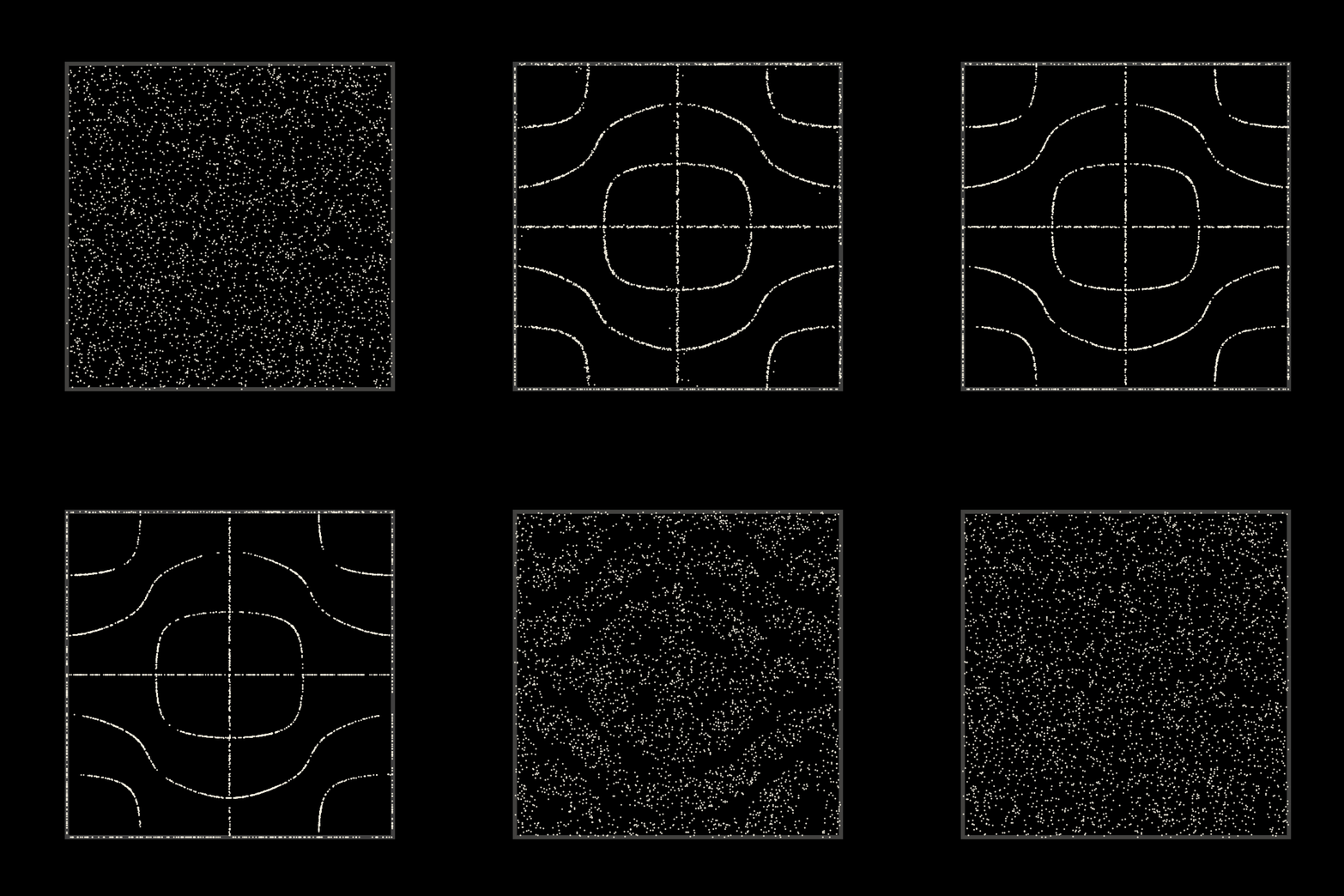
Examples of Chladni's Resonance at Distinct Frequencies.
Reflections at velocities faster than the speed of light not only explain two paired particles, but additional pairing as well. It also completely verifies why affecting one particle instantaneously affects the other paired particle. Remember that matter moving faster than the speed of light leaves the observer's time frame, so from the observer's point of view time stops. Once again it is simply the illusion of being instantaneous for the entangled particles. It is this very feature of Quantum Entanglement that has left scientists puzzled for a great many years.