
GRAVIMETRIC RESONANCE
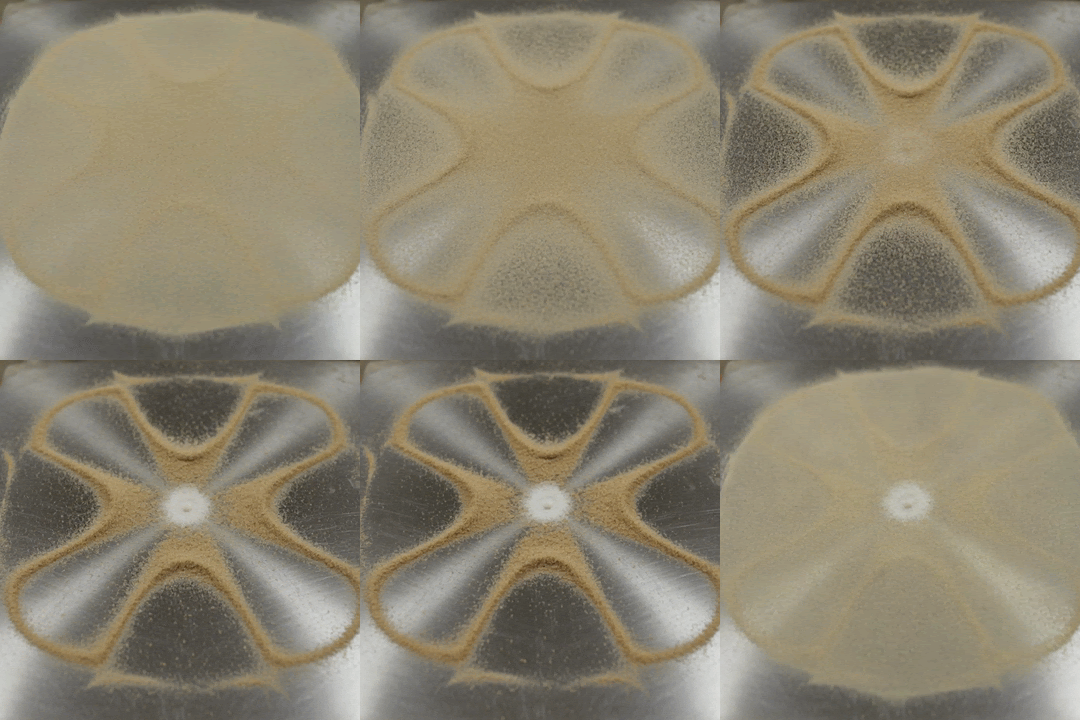
The science of gravimetric resonance is unquestionably still in its infancy. Yet the laws themselves, of wave resonance and fluid dynamics, have long since been established. Waves at specific, and very distinct frequencies interact with each other. This is often referred to as the science of Cymatics. Lower frequencies tend to create simpler patterns and higher frequencies tend to create more complex and intricate patterns. This was also briefly discussed in the section of quantum entanglement.
Gravitational waves themselves are now a well proven fact. Without doubt they completely permeate the entire universe. They are massive ripples in both space and time.
Additionally, gravity binds all matter in the universe, both relativistic, and non-relativistic alike. Dark matter itself, which is certainly relativistic, is gravitationally bound and interacts with our well known non-relativistic universe.
Video Illustration of Chladni's Resonance at a Distinct Frequency.
Therefore gravimetric resonance should be no surprise with respect to dark matter. However, since dark matter exists beyond the speed of light, and has moved beyond our frame of reference, any recognition of patterns would be extremely difficult. The one possible exception being, the overall shape of a dark matter field.
The effects of gravimetric resonance can be clearly seen when our solar system is viewed from the top down. Gravimetric resonance precisely explains the locations of the asteroid belts. It also further explains the non-congealment of the asteroid belts.
This is why no planets have formed there, and it's unlikely none ever will.
Gravitational waves have frequencies that are often measured in great distances. Therefore they are very low frequencies and produce very simple patterns such as the pattern when viewing our solar system from above.

Kepler map of the Milky Way Galaxy (Courtesy NASA)
It is also conceivable that gravimetric resonance may also play a role in the large-scale structure of the universe itself, as seen in the previous image by the Planck Satellite map of background radiation.
Our knowledge of gravimetric resonance and its interactions with the entire universe is truly just beginning. But there are now many new places for further research.

While approximately 60% to 75% of galaxies are spiral galaxies, it should be noted that not all galaxies are spiral galaxies. These apparently do not exhibit this easily observed phenomenon. However, gravimetric resonance unquestionably still plays an important role in their overall structure.

Spiral Galaxy M81 (Courtesy NASA)
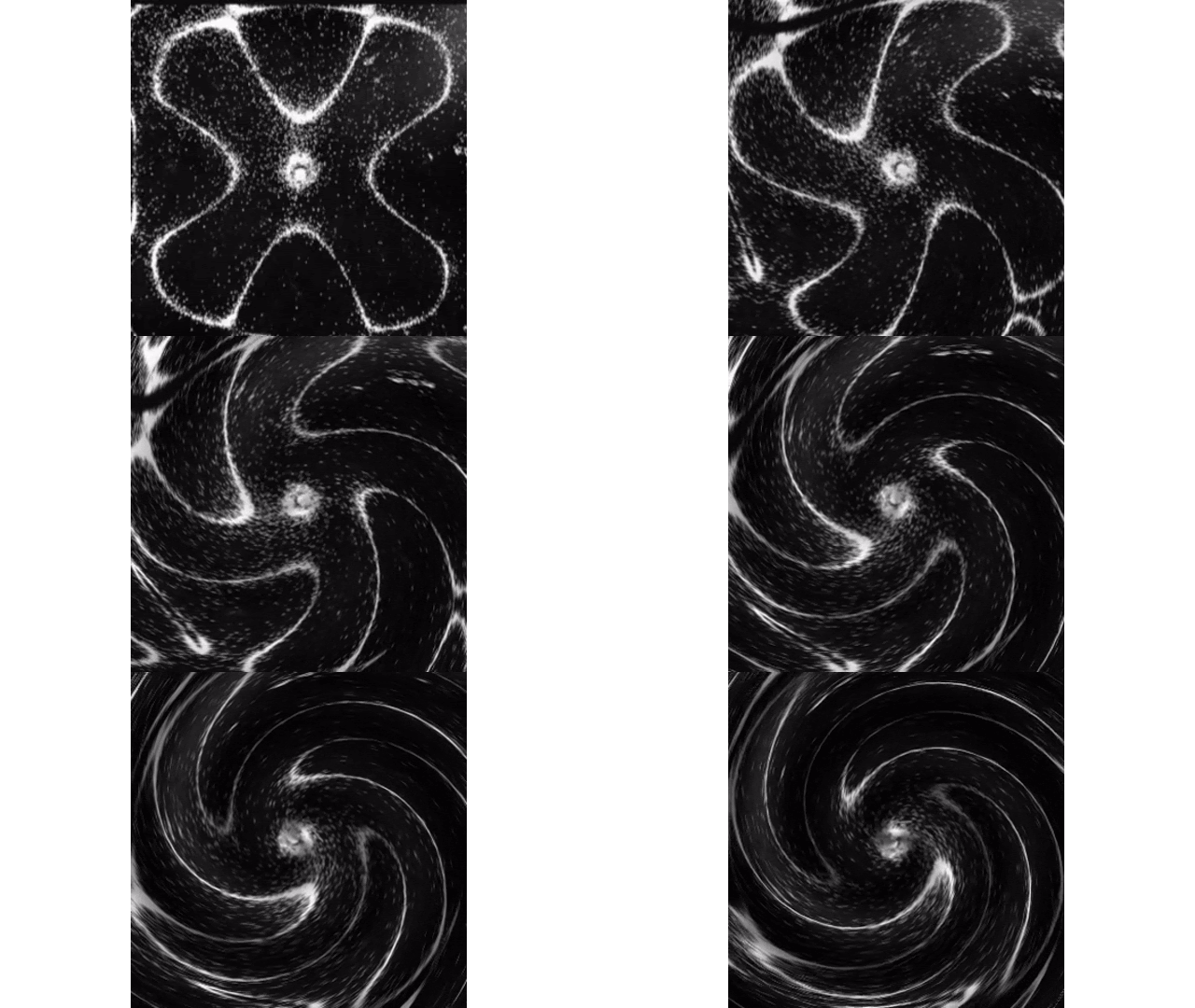
Computer Illustration of Gravimetric Resonance creating Spiral Arms

SUBATOMIC PARTICAL PHYSICS
Given our new knowledge of Apparent Mass and the speed of light, it now also becomes necessary to reevaluate our current thinking on many fundamental particles. In particular, the much more than just coincidental, similarities between Electrons, Muons and Tau Particles.
Each of these particles share nearly identical properties with the exception of mass, and most importantly, different lifetimes as a consequence of larger Apparent Mass.
Remember that larger Apparent Mass means the ability to do more work, or more properly stated, interact more readily. Much like the difference between infrared radiation and gamma radiation. Exactly why infrared radiation and microwaves are often used to heat foods. Whereas gamma radiation would simply pass directly through without significantly affecting the food's temperature.

There is unquestionably a striking resemblance between electrons, muons and tau particles. The only difference being their mass. The charges and spins are identical. In fact, extrapolating even a bit further, it is quite conceivable that all Leptons might indeed be iterations of just one simple particle, the electron. This also has to include neutrinos which by virtue of their velocity and consequent Apparent Mass interact precisely as C+ predicts. Their charge is no longer detectable because of their extreme velocities being so very close to the speed of light. Once again further experimentation will unquestionably prove immensely beneficial.

The Principle of C+ predicts that leptons may indeed be nothing more than different iterations of an electron, simply measured at different velocities.
THE GREY AREA
When transitioning from subsonic to supersonic with respect to the speed of sound, it is not instantaneous. There is a region of transition that happens between Mach 0.8 and 1.2. It is often referred to as a region of instability. Exactly the same can be said for the transition to the speed of light. There is a gray area or transitional region. Much like the speed of sound, many unusual things happen within this region.
Matter very close to the speed of light exhibits a wealth of interesting properties. Within the gray area must also be somewhat of a finite boundary at the transition point. Because of the wave-particle duality of highly accelerated matter, some particles at the correct energies or velocities, wavelike behavior allows them to move between sub-light and faster than the speed of light, thus having a frequency so to speak. This unique feature has two remarkable attributes. One is, it clearly marks the boundary or transition point of the speed of light. The other becomes extremely important for solving one of quantum mechanics most interesting problems, that is of the existence of Virtual Particles, and how they work.
Erwin Schrodinger taught us for example, that electrons don't exist in just one place around an atom, but rather in a c loud. This Cloud is a direct result of the typical wavelike behavior of a particle very close to the speed of light. Werner Heisenberg further went on to teach us that the electron can never be accurately predicted to be in any one place, at any one time with great certainty, but rather only with a probability.
This is indeed one of the key features of Quantum Mechanics. The principle of C+ also teaches us that time, with respect to the stationary observer, stops at this transition point.
The wavelike feature of highly accelerated particles like an electron for example, causes them to exhibit the properties of frequency because of the disappearance and reappearance at the boundary transition point. Bouncing between slightly less than the speed of light, and slightly greater than the speed of light.

Virtual particles are particles that exist close to the speed of light, that can oscillate back and forth at the boundary, at specific frequencies.
While virtual particles have yet to be directly observed, they are indeed quite real and have observable effects that can be measured with great accuracy. Their properties are well established and understood consequences of quantum mechanics. Probably the most notable being the Casimir effect , first discussed in 1948 by Hendrik Casimir.
Because of the dance between the two frames of reference, the virtual frequency so to speak, time becomes a contributing factor to the difficulty in pinpointing a particle. Part of the time it's within the observer's frame of reference and part of the time it has crossed the boundary of C+, where time from the observer's point of view, has stopped momentarily. This is also why, as Heisenberg predicted, it's difficult to know exactly the precise position of the electron. By taking the frequency, as well as the losses of time between Frequency Peaks into account, Quantum Mechanics can now become more precise.
Matter and therefore time and gravity, do exist at velocities in excess of the speed of light. As the velocity approaches C, matter’s interactions begin to take on new characteristics. This is of course with respect to the observer’s frame of reference. These changes include Lorentz Contraction, change in Apparent Mass, Time Dilation and increasing C+ Transparency. As matter continues to be accelerated, its ability to interact additionally becomes diminished. Very near the transition point it becomes very difficult to detect, yet it still has the ability to interact, albeit a diminishing ability.